
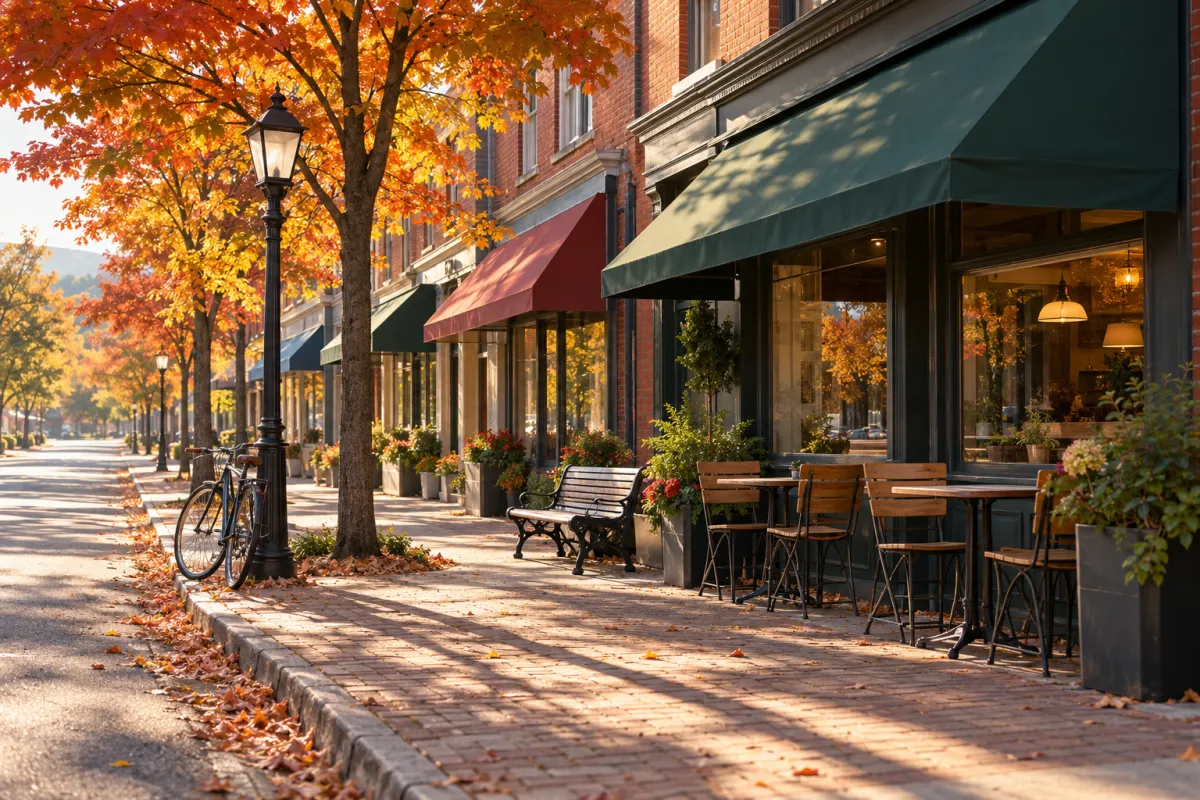
Most newcomers notice the same thing about small-town life: everyone already seems to know each other, and mostly they do. If you are working out how to meet people in a small town after a move, a breakup or a switch to remote work, that tight web can feel like a locked door. It isn’t locked. It is a different door, and it opens through repetition, local institutions and being useful, not through apps and big mixers.
Cities reward novelty: a new event every week, a fresh crowd at every meetup. Small towns reward showing up at the same place, at the same time, with the same people, until you stop being “the new person” and become “the one who helped at the pancake breakfast.” Below you’ll find the methods that work in places with one main street, a comparison table, scripts for what to say, three worked examples and a 4-week plan.
If you landed somewhere bigger, our 30-day plan for meeting people in a new city is a better fit. Everything here assumes limited options, long-standing friend groups and a community where people will remember whether you came back.
Why small towns work differently
Research supports the hunch that small places are more tightly knit: about 40% of rural adults say they know all or most of their neighbors, compared with roughly a quarter of adults in urban and suburban areas (Pew Research Center). The same body of research describes rural adults as unusually rooted: many have lived in one area for decades or grew up nearby, so friendships often build on family ties, school connections and institutions like churches, and when rural Americans take part in clubs or community groups, they are more likely to do it strictly in person rather than online (Pew Research Center).
Contrast that with the national picture. Only about 40% of Americans talk to their neighbors at least a few times a week, and nearly 1 in 5 say they never talk to their neighbors at all (Survey Center on American Life). In many places the casual neighbor conversation has faded. In a small town, it is still a realistic opening move.
Here is what that means in practice:
- The network is already built. You won’t find a crowd of other newcomers to bond with. Instead you plug into existing institutions: the library, the school, volunteer crews, churches, the rec department. Those are your on-ramps.
- Trust is high, but it is earned through reliability. People notice whether you show up the second, fifth and tenth time. Consistency counts for more than charm.
- In person is the default. The town Facebook group is a bulletin board, not the room. Use it to find out what’s happening, then go.
- Everything overlaps. Your running partner’s sister may be your kid’s teacher. Friendships form faster, and reputations travel faster too.
A note from us: MeetNow, the app we’re building, is organized around plans rather than profiles: a host posts a plan at a public place and picks who joins. Plans are starting in Malta, so in US and Canadian towns the methods below are your toolkit. The Android app is on Google Play; the iPhone app is not in the App Store yet.
Methods compared: cost, effort and speed
For a broader ranking that includes city-only options, see our guide to 15 ways to meet new people, ranked. In a small town, the shortlist looks like this:
| Method | Cost | Effort | How fast you meet people | Best for |
|---|---|---|---|---|
| Becoming a regular at a café or diner | Price of a coffee | Low | Slow: weeks of nods before real talk | Remote workers |
| Library programs | Usually free | Low | Medium | Introverts, parents |
| Volunteering | Free | Medium | Fast | Almost everyone |
| Run club or walking group | Usually free | Medium | Fast | Morning people, active types |
| Rec league | League or team fee, varies | Medium | Fast | People who like a bit of competition |
| Faith community or community center | Free, donations optional | Medium | Medium to fast | People who share the values |
| Classes (continuing ed, extension, shop workshops) | Varies by course | Medium | Medium | Skill builders |
| Neighbor rituals | Free | Low | Medium | New homeowners and renters |
| Hosting something small | Snacks or a round of coffee | High | Fast, once you know a few people | Anyone rebuilding |
| Local online groups | Free | Low | Slow, unless you go to the events | Finding what exists |
Costs are described in general terms because they vary widely from town to town. Confirm any fee with the organizer before you sign up.
How to meet people in a small town: 9 methods that work
Before you start, spend an hour finding out what exists. Check the library calendar, the parks and recreation page, the local paper’s community listings, bulletin boards at the grocery store and hardware store, and the town Facebook group or Nextdoor. Write down anything that repeats weekly or monthly. Repeating things are where friendships form.
1. Become a regular at one third place
The Survey Center on American Life links the availability of third places such as cafes, parks and community centers to stronger social trust and neighborliness (Survey Center on American Life). In a small town, the diner counter or the bakery is often the main one. Pick one spot and go at the same time on the same days. Sit at the counter rather than a corner table. Learn the staff’s names, because they are the town’s connectors and will eventually introduce you to other regulars.
2. Use the library for more than books
Small-town libraries often run book clubs, craft circles, seed swaps, author talks and story times. These events are structured, quiet and repeat on a schedule, which makes them ideal if big groups drain you. Our guide to making friends as an introvert has more low-energy options. Tell the librarian you’re new: librarians know which programs have a friendly core group.
3. Volunteer where the town actually needs hands
Food pantries, volunteer fire department auxiliaries, school booster clubs, historical societies, animal shelters and festival committees all rely on the same small group of people, and they are usually thrilled to see a new face. Volunteering is fast because you get a shared task, a recurring schedule and longtime locals who will introduce you around. Ask the organizer, “What do you need help with that nobody wants to do?” That person will remember you.
4. Join or start a run club or walking group
A weekly group run gives you the same faces on the same route every week, with side-by-side conversation that feels easier than sitting across a table. There’s a full walkthrough in the next section.
5. Play in a rec league
Call the parks and recreation department and ask about adult leagues: softball, volleyball, pickleball, bowling, or curling if you’re in Canada. Ask to be put on the free-agent list if you don’t have a team. A season gives you a fixed group of people every week for months, plus the natural follow-up of going out for food after games.
6. Try a faith community or community center
As the research above suggests, churches are often central to small-town social life. If you share the faith, attending regularly and joining a committee or small group is one of the fastest routes in. If you don’t, look for secular equivalents: the community center, a grange or Legion hall, or service clubs such as Rotary or Lions, which often run local projects. Don’t pretend to believe something to fit in; it tends to backfire in a place where everyone talks.
7. Take a class
Community college continuing education, cooperative extension programs in the US, quilting or knitting shops, and hardware store workshops all draw locals who want to learn something. A class with a project gives you an easy conversation starter every week. For more ideas, see our list of hobbies ranked by social payoff.
8. Say yes to neighbor rituals
Waving from the porch, helping shovel snow, lending a ladder, bringing a dish when someone is sick: these small exchanges are how trust starts in a small town. Accept every first invitation from a neighbor, even to the school fundraiser or the church chili cook-off. A first “no” can quietly become the last invitation.
9. Host something small
After three or four weeks of showing up, flip the direction. Invite three to five people you’ve met to something low-stakes in a public place: a board game afternoon at the café, a trail walk, breakfast at the diner. Hosting turns separate acquaintances into a group, and a group is much easier to keep alive than a string of one-on-one plans.
How to meet people at a run club
Knowing how to meet people at a run club is especially useful in a small town, because the club often draws from every corner of the community: teachers, farmers, nurses, retirees and remote workers on the same road at the same hour. Many groups also stop for coffee afterward, which is where the real conversations happen.
Finding one
Ask at the local running or sporting goods store, call parks and recreation, check the town Facebook group, or contact whoever organizes the local 5K or fun run. High school cross-country coaches sometimes know about informal adult groups too. If nothing turns up, you can start one (see below).
A worked example: your first six weeks
- Week 1: Message the organizer: “Hi, I just moved here and I’d love to join the Saturday run. I’m slow, is that okay?” Arrive a few minutes early, introduce yourself and ask which pace group to join. Run near the back: that’s usually where the talkers are.
- Week 2: Same run, same time. Learn two names and use them when you say goodbye.
- Week 3: Stay for coffee afterward. Ask a local-advice question, such as where people get their car fixed or which trail is best in the fall.
- Week 4: Offer to help: carry water to the turnaround, set up cones, volunteer at the next race.
- Weeks 5 and 6: Make one invitation: “I’m trying the river trail on Sunday morning. Want to come?” Or ask to tag along on a run someone else mentioned.
If you’re not a runner
Walking groups and dog-walking meetups work the same way. If you need to start your own, keep it simple: same public starting point, such as the library or the park, same time every week, all paces welcome. Post it on the town Facebook group and the library bulletin board, and show up even if only one person comes. Consistency is what makes it grow.
What to say: scripts for small-town situations
Small-town small talk works best when it is about the town itself. People enjoy being the expert on their home, and advice questions give you a natural reason to follow up. If opening your mouth is the hard part, our guide to putting yourself out there in small steps has more scripts.
- At your regular café: “I’m new in town and still figuring out where people go. What do you like around here?”
- At a volunteer shift: “How long have you been doing this? What got you started?”
- To a new neighbor: “We just moved in next door. If you ever need someone to grab your mail or feed the cat, I’m around.”
- Following up on advice: “I tried the mechanic you recommended. You were right, thank you.”
- Turning an acquaintance into a plan: “I keep meaning to try that diner out by the highway. Want to get breakfast there one weekend?”
- After a good conversation: “Good talking with you at the pantry. I’ll be at the farmers market Saturday if you’re around.”
- Joining an established group: “Would it be okay if I tagged along next time? Happy to bring something.”
- After a no: “No worries at all. Maybe another time.” Then invite them again in a few weeks; in small towns, timing and busy family schedules explain most declines.
How to rebuild a social life in a small town: a 4-week plan
If you’re wondering how to rebuild a social life from close to zero, start here. This plan assumes a few hours a week. The goal by the end of week four is not a best friend. It is recognition: a handful of people who know your name and expect to see you.
Week 1: Map and commit
- List every recurring activity you can find: library programs, parks and rec leagues, volunteer groups, run clubs, faith and community center events.
- Choose two anchors: one active (run club, league) and one service-based (pantry, committee). Add one third place.
- Attend each once and introduce yourself to the organizer by name.
Week 2: Repeat and learn names
- Go back to both anchors. Afterward, jot down names and one detail about each person in your phone notes.
- Have three short conversations with neighbors, even if they’re only about the weather or trash day.
Week 3: Be useful and make one ask
- Take on a small job: setting up, cleaning up, offering a carpool.
- Make one low-stakes invitation, such as coffee after the run or lunch after a volunteer shift.
Week 4: Host or join
- Host a small plan in a public place for a few people you’ve met, or accept every invitation that comes your way.
- Review: which anchor felt good? Keep it, drop the weaker one and try a new one in its place.
After week four
Keep your anchors going for months. Small-town friendships compound slowly, then quickly: once one well-connected person vouches for you, invitations multiply. Say yes to the “boring” events too, such as the school play, the fundraiser or the town meeting. That’s where you get seen.
Worked examples: three starting points
These are composite examples to show how the plan adapts, not real case studies.
After a move: Maya, 31
Maya moved for a hospital job with rotating shifts, so most scheduled events clashed with work. She picked anchors that repeat on weekends and daytimes: the Saturday food pantry and a library knitting circle. In week three she offered to drive the pantry van. By week five, an older volunteer invited her to a family cookout, where she met half a dozen people her age. Lesson: older locals are often the best connectors.
After going remote: Jordan, 34
Jordan’s remote job meant days blurred together, a pattern we cover in our guide to remote work loneliness and a weekly fix. He made the café his office two mornings a week and joined a rec volleyball league as a free agent. He opened with the barista: “I work from home and I’m going a bit stir-crazy. Is it always this busy on Tuesdays?” After a month his teammates added him to their group chat, and he hosted a board game afternoon at the café.
After a breakup: Chris, 29
Chris stayed in town after a breakup, which meant sharing a friend group with his ex. Rather than compete for mutual friends, he built a separate circle in places his ex didn’t go: the run club and an extension gardening course. He kept the breakup out of small talk and told mutual friends plainly, “You don’t need to pick sides. I’d still love to see you.” Within a couple of months he had a social life that felt like his own.
Small-town etiquette and common mistakes
- Comparing out loud. “In my old city we had…” lands badly. Ask what the town does well instead.
- Quitting after two visits. The first few times, people are watching to see if you’ll stick. Give each anchor at least six weeks.
- Gossiping. Everything travels. Being known as discreet is a huge asset.
- Oversharing early. Save the breakup story or the job drama for people you know well.
- Waiting to be invited. Locals already have full calendars with family and old friends. Newcomers usually have to make the first invitation.
- Overlooking older residents. Retirees run many of the town’s institutions and love introducing people.
- Joining everything at once. Eight activities attended once each beat nothing, but two attended every week beat eight.
Meeting someone new safely
Small-town trust is real, but the basics still apply when you meet someone new. Meet for the first time in a public place such as a café, park or library event. Tell a friend or family member where you’re going and when you expect to be back. Have your own way home, which matters in towns without rideshare. Leave if anything feels off; you don’t owe anyone an explanation. When something is posted in an online group, favor events organized by someone other locals know over one-on-one meetings with strangers.
Want to turn this into an actual plan? MeetNow is a free app for meeting people in person: a host posts a plan at a public place, says who pays (host pays, split, pay your own or free) and picks who joins. It is live on the web and works in your browser, starting in Malta. The Android app is on Google Play; the iPhone app is not in the App Store yet. Open MeetNow and see the plans posted in Malta.
Frequently asked questions
How long does it take to make friends in a small town?
Expect months rather than weeks. Within the first month you can realistically reach recognition: people know your name and expect to see you. Real friendships usually follow after several months of showing up to the same things consistently, plus a few one-on-one plans.
Is it harder to meet people in a small town than in a city?
It is different rather than harder. There are fewer events and fewer newcomers, but people are more likely to know their neighbors and groups tend to meet in person, so once you’re part of a recurring group, you get introduced around faster than in a city.
How do I meet people in a small town if I work remotely?
Build in-person anchors into your week: work from the same café or the library two mornings a week, join one recurring group like a rec league or run club, and volunteer for a weekend shift. Remote workers need more structure because the workplace no longer supplies casual contact.
What if my town doesn’t have a run club?
Ask the local running store, the parks and recreation department or the town Facebook group first. If nothing exists, start a simple weekly walk or run from a public spot such as the library or park, at the same time every week, with all paces welcome. Consistency matters more than size.
How do I rebuild a social life in a small town after a breakup when we share friends?
Don’t ask mutual friends to pick sides, and keep the breakup out of conversations in new groups. Build a separate circle through activities your ex doesn’t do, such as a new class, volunteer role or sports league, so you have a social life that is yours.
Is it safe to meet people from a local Facebook group?
It can be, with basic precautions. Meet first at a public place, tell a friend where you’re going and when you expect to be back, have your own way home and leave if anything feels off. Group events organized by someone others in town know are a safer first step than one-on-one meetings with strangers.