
If you are wondering how to find community in a new city, the short answer is this: pick two recurring groups that meet at the same time every week or two, show up at least six times before you judge them, and say yes to whatever small job the organizer offers. Community is not a place you find on one big night out. It is the same faces, in the same room, on a schedule, until people start to expect you. The 12-week plan below turns that into concrete steps for your first three months after a move.
This guide is for adults who moved to a US or Canadian city for a job, school, a partner or a lower rent and now want to belong to something, not just collect acquaintances. If you are still unpacking, start with our checklist for your first weeks in town; if you want the bigger picture of starting over solo, read our guide to moving to a new city alone.
What “community” actually means after a move
Most advice about a new city mixes up two different things. One is meeting people: going to events, chatting, swapping numbers. The other is belonging: being part of a group that would notice if you stopped coming. You need both, but they work differently.
Meeting people is about volume. Belonging is about repetition. A great one-off mixer gives you ten names you will probably never see again. A slightly awkward Tuesday volunteer shift gives you the same six people every week, and by week five somebody is saving you a seat. That is why this plan is built around recurring groups and institutions (run clubs, leagues, congregations, volunteer crews, library programs) rather than events.
A useful test for any group you try: does it meet on a fixed schedule, is it small enough that people notice newcomers, and is there something to do besides talk? If the answer to all three is yes, it is a community candidate. If it is a one-time ticketed event, it belongs on your “meeting people” list instead, and our guide to third places where regulars gather covers the cafés, bars and gyms that sit in between.
8 types of community to try (and who each suits)
You do not need all eight. Read the list, circle two that fit your schedule and personality, and keep one as a backup.
1. Faith communities
Churches, synagogues, mosques, temples and meditation centers are some of the most reliable community builders in North America because they combine weekly attendance with smaller subgroups: young adult groups, choirs, service teams, study circles. If faith is part of your life, this is often the fastest route. Go to the main service twice, then join one small group; the small group is where friendships form. Many congregations also welcome people who are exploring rather than committed, but ask rather than assume.
2. Volunteering
Volunteering gives you a built-in reason to talk and a shared task, which takes pressure off small talk. Look for roles with a fixed weekly or biweekly shift (food bank sorting, animal shelter walks, literacy tutoring, park cleanups) rather than one-day events. In the US, the big volunteer-matching platforms Idealist and VolunteerMatch merged in 2025 and now run as one Idealist listing, so that is a sensible first search; your city’s volunteer center or 211 line is another. Tell the coordinator you just moved and want a regular shift: coordinators love reliable people and often put newcomers next to friendly veterans.

3. Run clubs and walking groups
Many running stores and breweries host free weekly group runs with a social stop afterward, and most have a slow or walking group. The format is perfect for a newcomer: you run next to someone for 30 minutes, which is easier than face-to-face conversation, and the post-run coffee is where names stick. Check the club’s social media for pace groups before you go so you do not end up alone at the back.
4. Recreational sports leagues
Adult rec leagues (kickball, volleyball, softball, pickleball, soccer, bowling) run in seasons of several weeks, which is exactly the repetition you want. You can usually sign up as a “free agent” and get placed on a team. City parks and recreation departments run many of these at lower cost than private leagues; check your city’s rec guide for the next season’s registration window.
5. Library and parks-and-rec programs
Public libraries are underrated community hubs: book clubs, language conversation tables, craft nights, tech help sessions and author talks, usually free. Parks and recreation departments publish seasonal catalogs with classes (pottery, dance, fitness, cooking) that run for six to ten weeks. A class with the same 12 people every Thursday is a ready-made community.

6. Alumni chapters and professional associations
Your university’s alumni association probably has a chapter in your new city with happy hours, game-watch nights and service days. Professional associations in your field run local meetups too. These groups already share one thing with you, which makes the first conversation easy. If your job brought you here, ask colleagues which local chapters they belong to.
7. Cultural and language associations
If you have a heritage, a second language or a country you lived in, there is likely an association, a cultural center or a conversation group for it. These communities tend to be warm toward newcomers because many members were once new themselves.
8. Neighborhood groups
Buy Nothing groups are local gift-economy groups where neighbors give away and lend things for free. They run as volunteer-led local groups and through the Buy Nothing app; the project’s help center explains how to find the group closest to you. Picking up a free lamp is a small, low-stakes way to meet the people on your street, and some groups organize swaps or meet-ups. Block parties, community gardens and neighborhood associations work the same way. Our guide on how to meet your neighbors has door-knock scripts.
| Type | Typical rhythm | Typical cost | Best for |
|---|---|---|---|
| Faith community small group | Weekly | Free (donations optional) | People who value shared beliefs and service |
| Volunteer shift | Weekly or biweekly | Free | People who prefer doing over chatting |
| Run club or walking group | Weekly | Usually free | Active people, early risers |
| Rec league | Weekly for a season | Team or player fee, varies by city | Competitive or playful types |
| Library or parks-and-rec class | Weekly for 6–10 weeks | Free to low cost | Introverts, learners |
| Alumni or professional chapter | Monthly | Often free; some dues | Career-focused newcomers |
| Cultural or language group | Weekly or monthly | Free to low cost | Bilingual people, expats, heritage communities |
| Neighborhood group | Ongoing | Free | People who want local, walkable ties |
Costs are general ranges; check the specific group’s page before you sign up.
How to find community in a new city: the 12-week plan
The plan assumes about three to five hours a week. If you have less, stretch it to 16 weeks; do not cut the repetition. The goal is not to try everything. It is to try a few things briefly, then commit hard to two.
| Week | Action | Time / cost | Goal |
|---|---|---|---|
| 1 | List 6 candidate groups across at least 3 types; note day, time and distance | 1 hour / free | A shortlist that fits your real schedule |
| 2 | Try 2 groups (for example a library program and a run club) | 3–4 hours / free | First impressions, one name from each |
| 3 | Try 2 more groups; email one organizer to introduce yourself | 3–4 hours / free to low cost | Know which groups feel welcoming |
| 4 | Choose your 2 “anchor” groups; sign up for a season or a regular shift | 3 hours / possible league or class fee | Commitment on the calendar |
| 5 | Attend both anchors; learn 3 names at each and write them down | 3–4 hours | Be recognized by at least one person |
| 6 | Attend both anchors; volunteer for one small task (set-up, sign-in, snacks) | 4 hours | Move from guest to helper |
| 7 | Attend both; suggest a 30-minute coffee or walk with one regular | 4–5 hours / a coffee | First one-on-one outside the group |
| 8 | Attend both; join the group chat or mailing list properly; go to any social add-on | 4–5 hours | Be in the loop, not just the room |
| 9 | Host one small plan for 3–5 group members (pay your own or split) | 2–3 hours / your own share | Become a connector, not only an attendee |
| 10 | Attend both; follow up with anyone you clicked with | 4 hours | Two people you could text for a plan |
| 11 | Review: keep, swap or deepen each anchor; drop what drains you | 1 hour plus normal attendance | An honest check-in |
| 12 | Set a repeat: a monthly plan with your favorite people from the groups | 2–3 hours | A recurring thing that is partly yours |
Two notes on the table. First, the “host one small plan” step in week 9 is where community starts to feel like yours: a post-run breakfast, a trivia team, a picnic after the volunteer shift. Keep it small and at a public place, and say up front how the bill works. Second, week 11 matters. Some groups look good on paper and feel cold in person. Swapping one anchor at week 11 is normal and not a failure.
The six-visit rule (and the research behind it)
Why six visits? Because friendship takes time together, and most people quit groups after one or two awkward evenings. Communication researcher Jeffrey Hall at the University of Kansas studied adults who had recently moved and were getting to know new people, plus first-year students. As the University of Kansas summary of the 2018 study reports, it took roughly 50 hours together to go from acquaintance to casual friend, about 90 hours to become a friend, and more than 200 hours to become a close friend. We break the numbers down further in how long it takes to make a friend.
Those hours add up fastest in recurring groups. A two-hour weekly league plus a one-hour weekly run is 36 hours over 12 weeks with the same people, before any coffee or plans on the side. Six visits is simply the point where most people stop seeing you as “the new person” and start seeing you as “one of us.” It is a rule of thumb, not a scientific threshold, but it stops you from judging a group on the night everyone was tired.
Hall’s research also found that how you spend the time matters: hanging out and joking around helps more than time spent together at work on tasks. In practice that means the after-run coffee, the post-shift taco run and the chat while stacking chairs are not extras. They are where the friendship hours happen.
Scripts for organizers, regulars and follow-ups
Most newcomers stall at one of three moments: the first contact, the first “let’s hang out,” and keeping it going. These scripts are short on purpose. Change the words so they sound like you.
Emailing an organizer before your first visit
“Hi Sam, I just moved to the area and saw your Thursday group on the library calendar. Is it okay for a newcomer to drop in this week, and is there anything I should bring? Looking forward to it. – Alex”
Organizers almost always reply, and they will often introduce you to someone on the night.
At the group, to a regular
“I’m new here and to the city. How long have you been coming? Any tips for a first-timer?”
Asking for advice works because it gives the other person an easy, flattering role.
Offering to help (week 6)
“I’d like to be more involved. Is there anything you need help with, like set-up or sign-in?”
First one-on-one invitation (week 7)
“I’m getting coffee after this on Saturday. Want to come? No pressure if you’re busy.”
Specific beats vague. “We should hang out sometime” rarely becomes a plan; a day and a place usually does. For more wording, see our guide on how to ask someone to hang out as a friend.
Hosting a small group plan (week 9)
“A few of us are going to the diner on Main after Sunday’s run, around 10:30. Everyone pays their own. Who’s in?”
Saying “pay your own” or “let’s split it” in the invite removes the most common awkward moment of a group meal before it happens.
A worked example: Maya’s first 12 weeks
Maya, 29, moved from Ohio to Denver for a nursing job with rotating shifts. Here is how the plan played out, as a composite example of what usually happens.
- Weeks 1–3: She listed six options and tried four: a Saturday run club, a library book club, a food bank shift and a church young adults night. The book club met when she usually worked, so it went.
- Week 4: She chose the run club (Saturdays, fits every rota) and a biweekly food bank shift as anchors.
- Weeks 5–8: She learned names, took over the sign-in sheet at the food bank, and got coffee with Priya from the run club after week 7.
- Week 9: She hosted a post-run brunch for four people, pay your own. Three came.
- Week 11: The food bank shift felt friendly but quiet, so she kept it for the purpose and added a parks-and-rec climbing class for social energy.
- Week 12: The brunch became a “first Saturday of the month” thing. She now has two people she can text on a bad day and a group that notices when she misses a run.
Nothing in that story is dramatic. That is the point: community comes from boring consistency, not from one perfect event.
Staying safe while you try new groups
Recurring groups attached to a library, congregation, store or city program are generally low-risk, but a few habits help whenever you meet someone new one-on-one or in a small group:
- Meet at a public place for the first few plans (a café, a park, a busy restaurant).
- Tell a friend or family member where you are going and when you expect to be home.
- Arrange your own way there and back, so you can leave whenever you want.
- Leave if you feel uncomfortable; you do not owe anyone an explanation.
Want to turn this into an actual plan? MeetNow is a free app for meeting people in person: a host posts a plan at a public place, says who pays (host pays, split, pay your own or free) and picks who joins. It is live on the web, so it works in your browser, starting in Malta. Open MeetNow and see the plans posted in Malta.
Frequently asked questions (FAQ)
How long does it take to find community in a new city?
Expect about three months of steady attendance before a group feels like yours, and longer before you have close friends there. Research from the University of Kansas suggests roughly 50 hours together to become casual friends and more than 200 hours for close friendship, so weekly groups are the fastest way to rack up that time.
What if I’m an introvert?
Choose groups with a built-in activity (volunteering, a class, a run) so you are not relying on small talk, and pick smaller groups over big mixers. Arriving five minutes early is easier than walking into a full room.
Do I have to be religious to join a faith community?
No, many congregations welcome visitors and people who are exploring, and some run community programs open to everyone. If you are not religious, volunteering, leagues and library programs offer a similar weekly rhythm.
How many groups should I join?
Two anchors is the sweet spot for most people. One group can disappoint you; three or more usually means you show up to each one too rarely to be remembered.
What if a group feels cliquey?
Give it the full six visits and offer to help with something, since helping changes how regulars see you. If it still feels closed after that, swap it out at your week 11 review without guilt.
Is it weird to start my own group?
Not at all. Once you know a few people, hosting a small recurring plan (a monthly brunch, a trivia team) is one of the best ways to turn scattered acquaintances into a community. Keep it at a public place and say how the bill works up front.
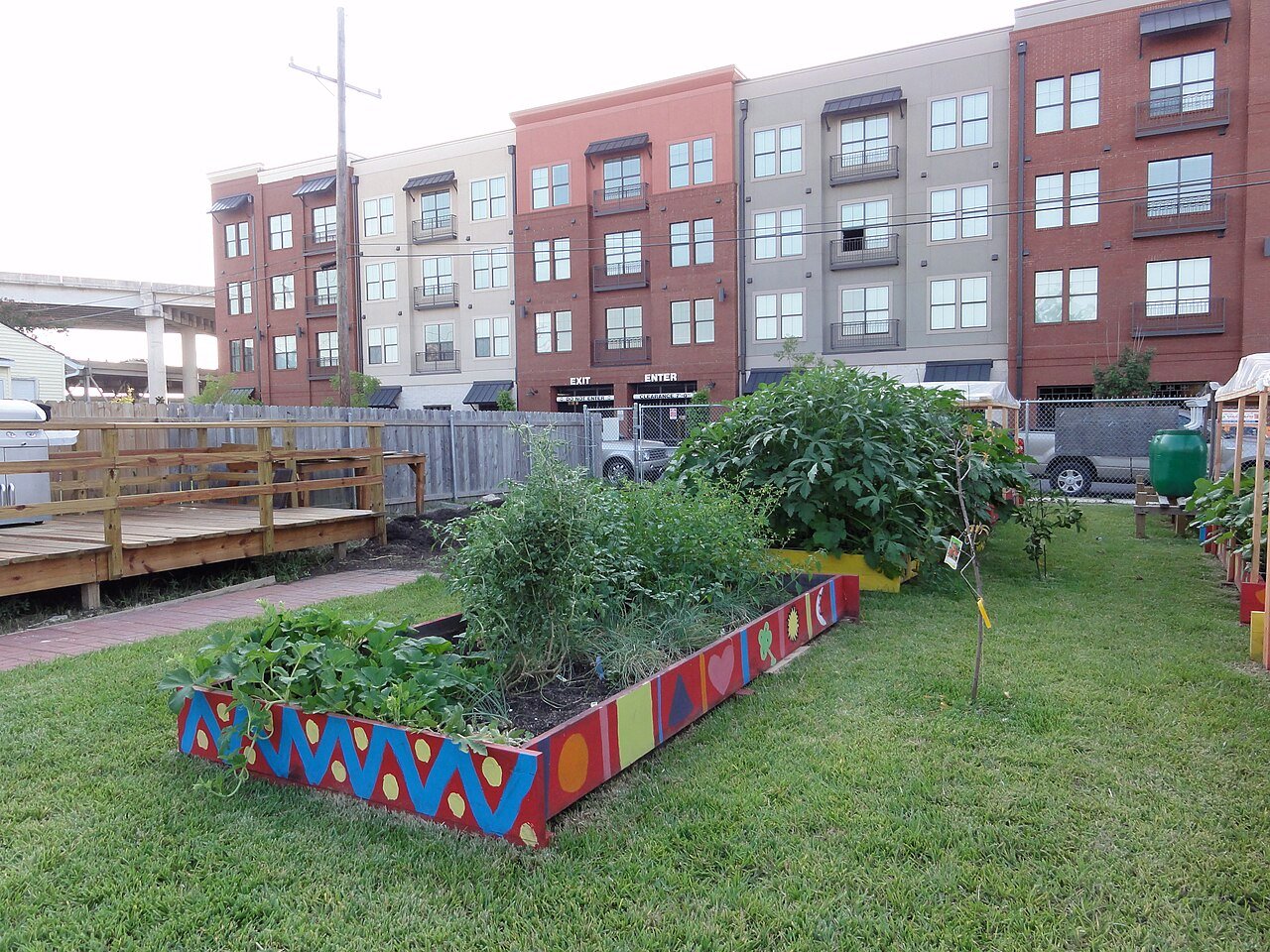
Featured image: raised beds at Wise Words Community Garden, Mid-City, New Orleans, photo by Bart Everson, CC BY 2.0, via Wikimedia Commons.